Thank you for Subscribing to Eldercare Review Weekly Brief
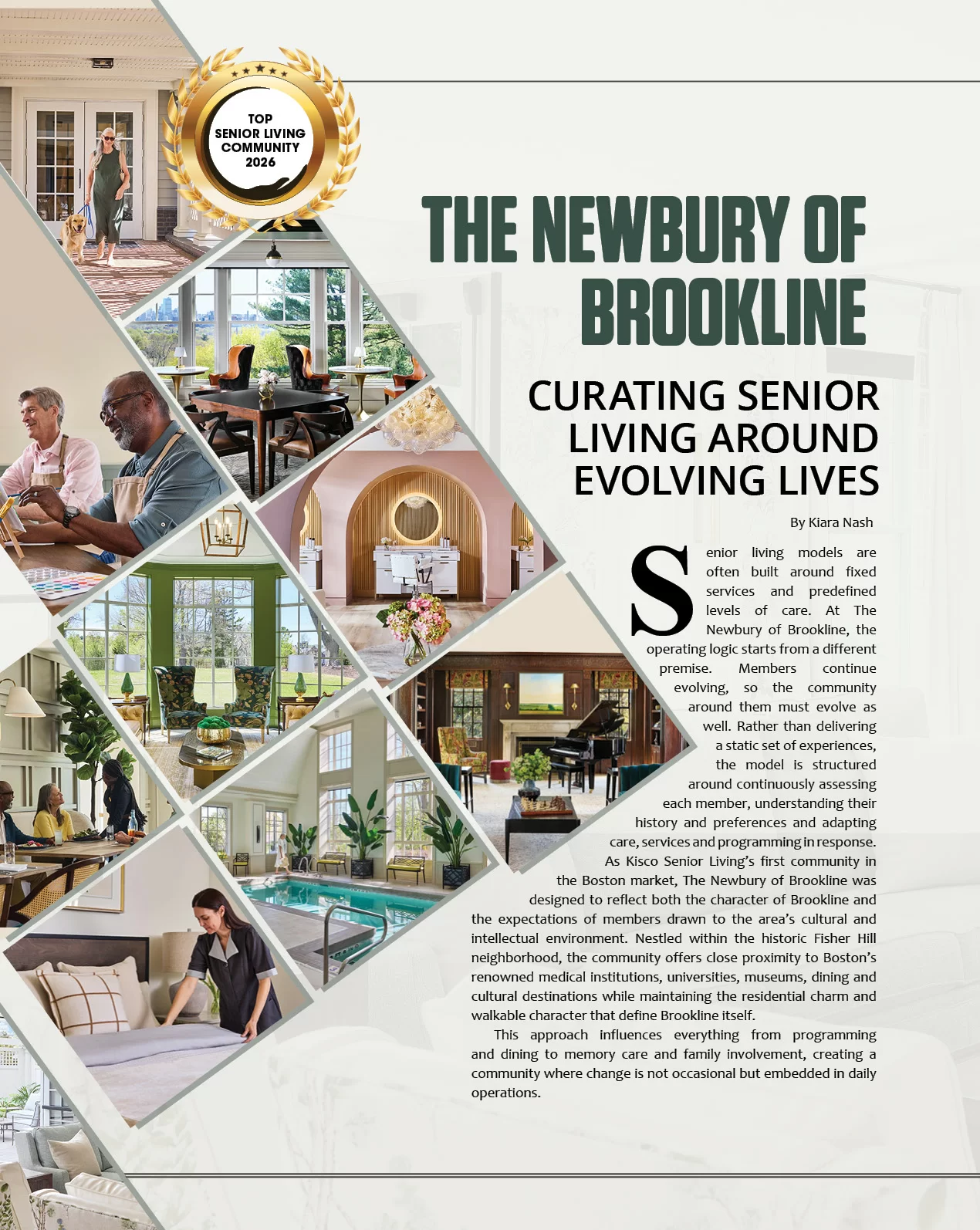
Senior living models are often built around fixed services and predefined levels of care. At The Newbury of Brookline, the operating logic starts from a different premise. Members continue evolving, so the community around them must evolve as well. Rather than delivering a static set of experiences, the model is structured around continuously assessing each member, understanding their history and preferences and adapting care, services and programming in response.
As Kisco Senior Living’s first community in the Boston market, The Newbury of Brookline was designed to reflect both the character of Brookline and the expectations of members drawn to the area’s cultural and intellectual environment. Nestled within the historic Fisher Hill neighborhood, the community offers close proximity to Boston’s renowned medical institutions, universities, museums, dining and cultural destinations while maintaining the residential charm and walkable character that define Brookline itself.
This approach influences everything from programming and dining to memory care and family involvement, creating a community where change is not occasional but embedded in daily operations.
There is no fixed program, the focus is on understanding what your loved one enjoys and responds to most.
“We continue adjusting and recreating our programs as our members give us their thoughts and preferences,” says Bates.
A Community Shaped by the People Who Live There
Member participation plays a meaningful role in shaping day-to-day community life. Many members arrive with rich professional and intellectual backgrounds, along with lifelong interests they are eager to continue pursuing. Instead of treating those experiences as background, The Newbury often treats them as the starting point for programming.
 A member speaker series was developed in response to recognizing that many members still wanted opportunities to teach, lecture and share ideas. Members now contribute talks and discussions that have become part of the community's intellectual life. A former judge introduced a courtroom-style program in which members serve as jurors in mock proceedings, adding another layer of engagement that feels purposeful rather than recreational. These programs are not standalone activities; they are designed to keep members mentally engaged and socially connected as part of their overall care.
The community’s connection to Boston’s cultural landscape also plays a meaningful role in member life. Partnerships with organizations such as the Museum of Fine Arts, Boston and the Boston Symphony Orchestra create opportunities for members to remain engaged with the city’s artistic and intellectual energy through special exhibits, performances and curated experiences that encourage continued learning, conversation and connection.
The same approach appears in smaller but equally important ways. Culinary programming is adjusted based on member preferences and feedback, with menus rotating regularly and dining treated as an evolving experience rather than a fixed service. Wellness programming is updated monthly, often incorporating new instructors or formats based on member interest. Members help influence these changes through the ordinary rhythm of community life.
 Hospitality operates within the structure of a high-end service environment, not just as a traditional senior living model. Concierge and valet services, dedicated transportation and multiple dining venues with rotating menus are embedded into daily operations. Culinary programming continues to adapt based on member input, while service delivery is reinforced through structured training influenced by Forbes hospitality standards. These elements support responsiveness, allowing teams to act quickly and tailor support at the individual level rather than operate within fixed service boundaries.
That distinction matters, particularly in a senior living environment where moving into a community can too easily be framed as leaving a prior way of life behind.
Carrying Lifestyle Across All Levels of Care
Continuity becomes even more important as support needs evolve. One of the strengths Bates returns to often is the effort to preserve identity and lifestyle across independent living, assisted living and memory care, rather than treating each as a fundamentally separate environment. The same approach to care, understanding the individual and adapting support, continues across each level.
Dining, programming and service standards remain thoughtfully consistent across all levels of living, helping reduce the feeling of transition.
Rather than experiencing a reset in lifestyle or environment, members continue to enjoy familiar routines, elevated dining, engaging programming and meaningful connections, all adapted with care to support their evolving needs.
Memory Care Shaped Around the Individual
Memory care offers perhaps the clearest example of that thinking in practice. The Heirloom Program, guided by Montessori principles, centers on meeting members where they are and creating engagement around what remains meaningful to them. Care is personalized around each member’s history, preferences and interests, with plans continuously adapted based on their individual responses and needs.
Examples Bates shares make that tangible. A member who deeply missed playing piano now performs for fellow members on a keyboard brought in specifically for him. Members with strong physical energy participate in customized exercise routines and outdoor programming. Others engage through art, music or experiences tied to lifelong passions.
-
We continue adjusting and recreating our programs as our members give us their thoughts and preferences.
“There is no fixed program,” she says. “The focus is on understanding what your loved one enjoys and responds to most.”
Care is shaped around a simple question: what does this person respond to, and how should support adapt to meet them where they are?
Family members often feel the difference in that model. Transitions into memory care often come with guilt, uncertainty and exhaustion, particularly when families feel they are giving something up. The community treats that transition as a shared process, helping families remain involved while building trust through familiarity and consistency. Personal stories shared by families often inform how support is crafted.
Hospitality Begins with People
A model built around that degree of adaptability depends heavily on culture. The Newbury places great emphasis on the people delivering the experience and often describes team members as the community’s greatest differentiator.
Hiring is deliberate and selective, with a focus on alignment and adaptability. The organization avoids hiring out of urgency and instead maintains flexibility through cross-trained teams capable of supporting multiple functions.
Team members are expected to operate with an entrepreneurial mindset, taking ownership of member experience without waiting for layered approval. That autonomy allows the model to function in real time. It enables teams to respond to individual care needs as they arise, rather than escalate through rigid processes.
“Our team members have a yes-first mindset. They always think, how can we make this happen?” Bates says.
Team members are encouraged to solve creatively, contribute ideas and adapt in the moment. Departments support one another. Empowerment operates as a practical necessity because a highly personalized model depends on people capable of thoughtful judgment.
Training reinforces that through extensive onboarding and hospitality standards shaped in part by Forbes service principles. Luxury, in this context, is defined less by formality and more by attentiveness, responsiveness and anticipation.
Members often recognize those qualities in everyday interactions more than in formal services.
Family as Part of Community Life
Family involvement represents another dimension of the community. They often arrive carrying guilt, uncertainty and exhaustion, particularly when transitioning a loved one into a new care environment. Helping them navigate that shift is treated as part of the responsibility of care.
 Conversations begin less as sales interactions and more as discovery, focused on understanding whether the community is genuinely the right fit. That orientation toward partnership continues after move-in.
Family dinners, celebrations and multigenerational gath-erings are woven naturally into community life. Members regularly host children and grand-children. Families often remain actively involved in events and programming. Common spaces are designed to feel residen-tial and welcoming, supporting continuity. Family life remains integrated into the experience rather than existing around its edges.
Recognition Earned through Practice
Bates does not frame the future as transformation, but as continued refinement as member needs and preferences evolve.
The Newbury of Brookline’s recognition as a Top Senior Living Community 2026 by ElderCare Review reflects the community’s highly personalized and hospitality-driven approach to senior living. Rather than relying on fixed service models, the community continuously adapts care, programming and daily experiences around the evolving needs, preferences and lifestyles of its members.
That philosophy has also earned broader national recognition. The Newbury of Brookline was recognized by U.S. News & World Report in its 2026 Best Senior Living ratings, receiving Best Assisted Living, along with additional recognition for excellence in Assisted Living – Caregiving, Activities & Life Enrichment, Feels Like Home, Food & Dining, as well as Independent Living – Food & Dining. Together, those recognitions reflect a model centered not only on quality care, but on preserving continuity, engagement and quality of life as member needs evolve.
To learn more about life at The Newbury of Brookline, visit LifeAtTheNewbury.com or call 617-941-9523 to schedule a personalized visit.
What Defines Excellence in Senior Living Communities for Discerning Residents
Senior living communities have entered a phase where expectations extend beyond clinical care and basic accommodation. Executives responsible for elder care investments now face a more nuanced mandate; deliver environments that balance clinical capability with lifestyle quality, while addressing rising expectations from residents and their families. The sector reflects a shift from institutional models toward experience-driven living, where personalization, service culture and adaptability shape long-term value.
One persistent challenge lies in aligning care delivery with evolving resident needs. Traditional models often rely on fixed service structures that struggle to accommodate the dynamic nature of aging populations. Residents transition across levels of independence, while their preferences, social engagement and wellness requirements shift over time. Communities that maintain static programming risk disengagement and diminished satisfaction, particularly among affluent or highly independent residents who expect continuity in lifestyle standards. Decision-makers must therefore prioritize environments that demonstrate the ability to adjust programming, services and care approaches in response to resident feedback and changing health profiles.
Another pressure point centers on service culture and workforce quality. Staffing shortages and inconsistent training continue to affect the sector, often resulting in uneven resident experiences. High-performing communities distinguish themselves through disciplined hiring practices and sustained investment in staff development. A service ethos that empowers personnel to respond flexibly to individual needs becomes essential. This is not limited to clinical staff but extends across hospitality, dining and lifestyle programming. The presence of a unified service standard, reinforced through structured onboarding and continuous training, signals a community’s ability to deliver consistent quality at scale.
"The sector reflects a shift from institutional models toward experience-driven living, where personalization, service culture and adaptability shape long-term value."
Lifestyle integration has also emerged as a defining factor in executive evaluation. Residents increasingly view senior living not as a care setting but as a continuation of their prior way of life. This expectation places emphasis on curated experiences, diverse programming and access to cultural, social and wellness opportunities. Communities that succeed in this area move beyond activity schedules toward comprehensive enrichment strategies that reflect resident interests. Dining variety, transportation access, wellness programming and opportunities for family engagement all contribute to perceived value. The surrounding environment also plays a role, particularly when proximity to medical infrastructure and cultural amenities enhances both convenience and quality of life.
Family engagement introduces another dimension that influences long-term satisfaction and occupancy stability. The transition into senior living often carries emotional complexity for families, requiring education and support alongside resident care. Communities that integrate families into the experience, offering transparent communication and opportunities for shared activities, tend to foster stronger trust and retention. This holistic approach acknowledges that elder care decisions rarely involve the resident alone, and that family confidence remains a critical factor in sustained occupancy.
Within this landscape, The Newbury of Brookline presents a compelling model aligned with these evolving expectations. It emphasizes a continuously tailored resident experience, adapting services and programming based on ongoing feedback rather than fixed offerings. Its approach integrates hospitality-driven service standards, supported by structured staff training that reinforces a consistent delivery ethos.
The community combines independent living, assisted living and memory care within a unified environment, while maintaining distinct experiences across each level. Its enrichment model focuses on curated events, diverse dining options and individualized engagement, complemented by concierge services, transportation and family-oriented programming. This combination positions it as a strong choice for organizations prioritizing adaptability, service consistency and lifestyle quality in senior living investments.
...Read more
Senior Living Communities Info
Q1
What Should Families Look for in Senior Living Communities?
Families often evaluate more than the services listed in a brochure when choosing among Senior Living Communities. Daily experiences, personal preferences and the overall living environment can be just as important as the care and amenities provided. Factors such as how staff interact with residents, the flexibility of dining options, the availability of wellness activities and opportunities for family involvement can provide valuable insight into community life. Spending time in the community and observing these aspects can help families make a more informed decision.
Q2
How Does The Newbury of Brookline Personalize Daily Life?
The Newbury of Brookline builds senior living around members who continue to change, not around a fixed schedule. It is Kisco Senior Living’s first Boston-market community and reflects Brookline’s Fisher Hill setting, with nearby access to medical, cultural and university resources. Member speaker sessions, courtroom-style discussions, rotating dining programs and cultural ties with the Museum of Fine Arts, Boston and Boston Symphony Orchestra show how Senior Living Communities can turn personal history into daily engagement.
Q3
Which Levels of Support Matter Most in a Community?
Residents may require different levels of support over time, making continuity an important consideration when evaluating Senior Living Communities. While independent living, assisted living and memory care each provide distinct services, many families value an environment where dining experiences, activities, staff interactions and community culture remain familiar. Consistency across these areas can help residents adjust more comfortably when care needs change. Maintaining established routines and social connections can also contribute to a smoother transition between levels of care.
Q4
Why Are Hospitality Standards Important in Senior Care?
The quality of day-to-day service can have a significant impact on the resident experience. Features such as concierge assistance, valet services, transportation options, multiple dining venues and well-trained staff can make everyday activities more convenient for both residents and their families. In many Senior Living Communities, these services complement care programs by supporting comfort and independence throughout the day. Staff interactions are equally important, as residents and families often form impressions based on how requests are handled and how consistently support is provided.
Q5
How Does The Newbury of Brookline Support Memory Care and Families?
Memory care is often hardest when families feel they are losing the person they know. The Newbury of Brookline’s Heirloom Program uses Montessori-informed practices to shape engagement around each member’s history, interests and responses. Examples include music, art, exercise and outdoor programming adjusted to the individual. That makes Senior Living Communities more personal and helps families remain part of the care experience. It also gives relatives concrete ways to share stories, preferences and familiar cues that can guide support.
Q6
How Should Families Evaluate Lifestyle, Care and Trust?
A thorough evaluation of Senior Living Communities often involves understanding how the community operates on a day-to-day basis. Families may wish to learn how resident feedback influences programs and services, how staff respond to changing care requirements and how communication is maintained with relatives. Questions about activities, dining preferences and care updates can provide a clearer picture of community life than a scheduled tour alone. Observing consistency across services and resident support can help families assess the quality of the overall experience.
Company :
The Newbury of Brookline
Management Fran Bates, General Manager
Description
The Newbury of Brookline is a luxury senior living community that blends hospitality-driven service with personalized care. Offering independent living, assisted living and memory care, it creates an engaging environment where lifestyle, comfort and wellbeing are thoughtfully prioritized.